
Fintech Forward Newsletter - Issue 33
22 September 2026
In this month’s newsletter we examine the increasing cost of AI and strategies for delivering ROI in financial services. We consider whether banks are becoming too reliant on a small group of AI technology companies, how private foundational AI models could reshape competitive advantage, and how leaders can move beyond experimentation with AI to delivering real tangible value.
Data from Moody’s highlights how banks are becoming increasingly dependent on a relatively small group of technology and cloud providers, raising concerns around vendor concentration, resilience, lock-in and rising costs. At the same time, the cost of running sophisticated AI is climbing as agentic systems consume more tokens and pricing continues to rise. For financial institutions, the question is no longer simply whether to adopt AI, but to ask whether it delivers a measurable return, and whether “good enough” technology may be the smarter choice.
Forrester highlights how the competitive landscape is changing. Banks and fintechs are recognizing the potential value to be gained from developing their own private AI models trained on proprietary transactional data and customer interactions – creating real intelligence that can underpin the delivery of advisory experiences and proactive support. But not every organization has access to the volume of data or AI expertise required, so the question becomes when best to build and when to buy.
As leaders navigate the AI landscape ahead, the upcoming Gartner IT Symposium, under the theme Ignite Intelligence, explores how best to combine human creativity with AI to increase agility, overcome disruption and deliver lasting value.
The true cost of AI
As firms expand their use of AI, the cost is growing considerably. A recent survey from McKinsey shows that 28% of firms are spending more than 10% of their entire technology budget on AI, and 60% expect AI investment to increase over the next year. But for what return?
AI forcing big banks to rely on tech firms
Moody’s warns that banks’ growing reliance on a small group of AI and cloud providers could create systemic risks, including outages, vendor lock-in, and future price increases. While AI may boost efficiency and revenue over time, banks will need to protect their proprietary data, diversify technology partners, and strengthen customer trust as competition and switching become easier.
The rise of private AI models in finance
Banks and fintechs are increasingly building private AI models trained on proprietary transactional and behavioral data to better predict customer needs, manage risk, detect fraud, and personalize experiences. Lasting advantage will come from unique feedback loops linking customer actions to real-world outcomes.
Top Takeaways
AI bills are exploding
Complex AI agents are consuming far more tokens, and token prices have risen more than 60% since December 2025. As heavy users quickly run up large bills, businesses are prioritizing AI use cases with clear ROI and considering lower-cost “good enough” models for everyday tasks.
Event
Gartner IT Symposium
The Gartner IT Symposium Expo 2026, taking place in Barcelona from 9-12 November, focuses on practical AI strategies and real-world use cases. The agenda looks at how best to align AI strategy to business outcomes, funding priorities, and enterprise transformation goals.

AR is not just a subscription
An analyst subscription provides access to research and insights, but it is not the same as an AR program. Effective AR is a proactive, ongoing effort to build relationships, shape analyst perceptions and increase visibility across both major analyst firms and influential independent experts.
Report
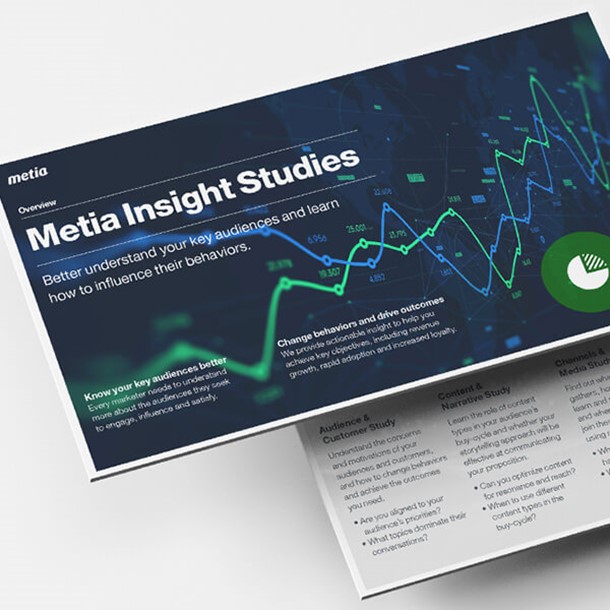
Metia Insight Studies
Use data driven insight to inform and improve your customer experiences, engagement and relationship strategies. Our insight studies give you actionable insights and practical recommendations, all built using advanced data science techniques and expert analysis.