
Fintech Forward Newsletter - Issue 35
11 November 2026
With financial crime and cyber-attacks almost ever present in the news, our team kicked off the month by attending the Financial Crime 360 conference in London on 2nd November. The event covered some of the industry's most pressing challenges from AI-enabled fraud, APP scams, AML, cybersecurity, cryptoasset regulation and digital identity, alongside the UK Fraud Strategy 2026–2029. Adopting this as the theme of our newsletter this month, we highlight how technology, innovation and collaboration are shaping the future of financial crime prevention.
The FCA is taking a proactive step by launching its Quantum Experimentation Group in Q1 2027, bringing together financial institutions, technology providers and researchers to explore how quantum computing and machine learning could strengthen the detection of fraud and money laundering. This initiative signals growing regulatory interest in emerging technologies and their potential applications in financial services.
Agentic AI is also gaining momentum across financial crime prevention, with banks increasingly exploring its potential to reduce the cost and manual effort involved in KYC and AML operations. However, scaling beyond individual use cases remains a challenge.
Meanwhile, Forrester's assessment of financial crime management solutions highlights the industry's shift towards integrated platforms that combine fraud prevention, AML, advanced analytics and AI, moving away from fragmented, siloed systems.
Finally, the recent Binance cyberattack demonstrates how attackers are becoming increasingly skilled at exploiting human vulnerabilities – in this case using fake recruitment processes and malicious software to compromise critical financial infrastructure. Financial crime teams must be alert to the risk of growing threats and proactively strengthen all lines of defence.
FCA explores quantum tech to fight financial crime
The FCA is launching the Quantum Experimentation Group in Q1 2027, bringing together financial institutions, technology providers and researchers to explore how quantum computing and machine learning could improve fraud and money laundering detection. The initiative aims to identify practical applications, understand the technology's limitations and help shape future regulatory approaches.
Agentic AI in fincrime prevention
McKinsey & Company explores how banks are adopting agentic AI to reduce the cost and manual workload of KYC and AML operations. However, many struggle to scale beyond a single use case, highlighting the importance of making the right strategic and operational decisions to achieve wider AI adoption.
Forrester Wave: Financial Crime Management Solutions
This evaluation of leading solution providers highlights the growing convergence of fraud prevention and AML through unified platforms, advanced analytics and agentic AI. Financial institutions are moving away from siloed fraud and AML systems towards unified, intelligent financial crime management.
Lessons for fincrime teams
The Binance hack highlights how cybercriminals can exploit human vulnerabilities, using fake job offers and malicious software to compromise critical financial systems. Key lessons include strengthening hiring and cybersecurity controls, sharing threat intelligence in real time and improving transaction monitoring to detect, freeze and recover stolen funds.
Event
Financial Crime 360
The Financial Crime 360 UK Conference in London brought together 1,500+ attendees, 80+ speakers and key regulators. Discussions focused on emerging financial crime threats, including AI-enabled fraud, APP scams, AML, cybersecurity, cryptoasset regulation, digital identity and the UK Fraud Strategy.

AR: The quality of the briefing matters more than you think
The idea for this blog came from a conversation with an analyst friend who made a simple but powerful observation: the quality of a vendor briefing is often what separates a productive analyst relationship from a missed opportunity. I couldn't agree more.
Report
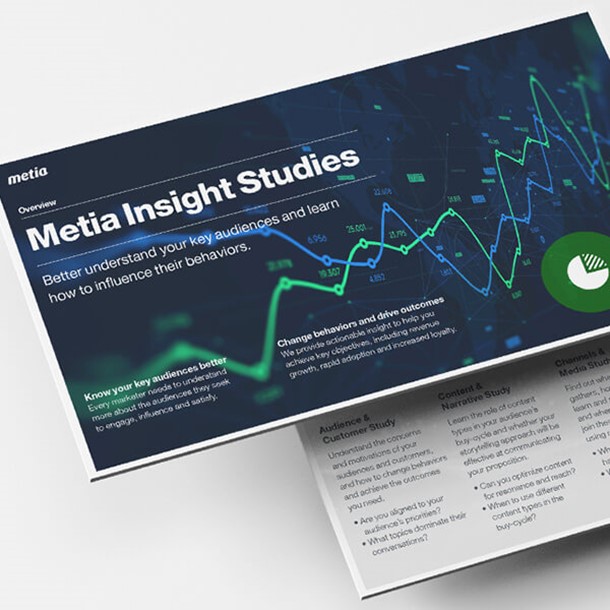
Metia Insight Studies
Use data driven insight to inform and improve your customer experiences, engagement and relationship strategies. Our insight studies give you actionable insights and practical recommendations, all built using advanced data science techniques and expert analysis.